

That’s the approach I’m taking with Mason Electric.
When I started working on the site, the immediate problem was its structure. Services had been published as blog posts, and the content on those pages was thin. Creating more pages around the same foundations would have multiplied the work before we had fixed the underlying issue.
So I started with the existing services: where they belonged, what they needed to explain, and how visitors would find them.
What we changed on Mason Electric
We moved the service content into the services section and set up permanent 301 redirects from the old URLs to their replacements. We rewrote the service pages, changed the site structure and redesigned the homepage.
There’s an important distinction here. A WordPress post can rank. Moving something from “Posts” to “Pages,” or adding /services/ to its URL, doesn’t make the content more useful on its own.
The problem was what these pages were doing for a potential customer. Someone looking for an electrician needs to understand the service, whether it fits their situation, and how to arrange the work. The existing thin content needed to be rewritten around that job.
The redirects were part of handling the move. When a service gets a replacement URL, visitors following an old link should reach the relevant new page. Google also needs to understand that the page has moved permanently. Its documentation on URL changes explains the migration process.
What I check when moving service pages
Direct 301 redirects
Does each old URL redirect directly to the appropriate replacement?
Updated internal links
Do navigation and in-content links point to the new URL?
Correct canonical URL
Does the replacement page use the intended canonical URL?
Sitemap & indexing
Is the new URL included in the sitemap and available for indexing?
These checks matter because rewriting a page and moving it are two different pieces of work. Both need attention.
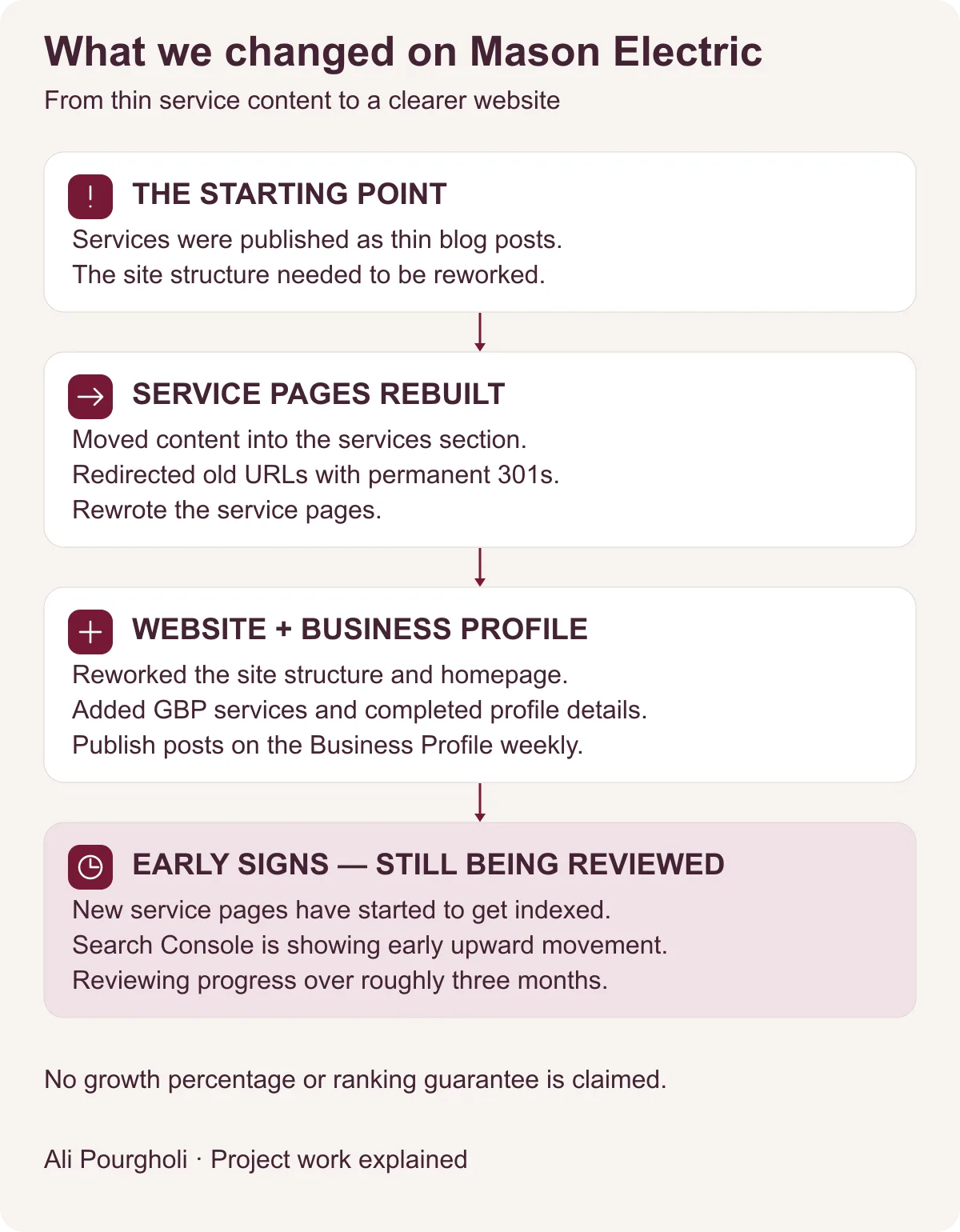
What we changed on Mason Electric
The starting point
Services were published as thin blog posts. The site structure needed to be reworked.
Service pages rebuilt
Moved content into the services section, redirected old URLs with permanent 301s and rewrote the service pages.
Website and Business Profile
Reworked the site structure and homepage. Added GBP services, completed profile details and publish posts weekly.
Early signs — still under review
New service pages have started to get indexed. Search Console is showing early upward movement. Reviewing progress over roughly three months; no growth percentage or ranking guarantee is claimed.
Why I avoided three city-specific Tesla charger pages
Consider these potential page titles:
- Tesla charger installation in Alpharetta
- Tesla charger installation in Johns Creek
- Tesla charger installation in Milton
I wouldn’t approve all three just because the business covers those cities.
First, I’d look at the main Tesla charger installation page. Does it answer the questions someone has before contacting an electrician? Does it explain coverage clearly? Is there enough useful information to help the customer describe the job?
For this service, the conversation may involve the charger model, the proposed installation position, the electrical panel and the distance between the panel and the charger. A good page can explain what information to send before an assessment and which details the electrician needs to check.
The business should confirm its actual process before those details go on the page. The same applies to pricing, permits, availability and installation claims.
Now compare that with three pages that repeat the same introduction, service description and contact form, changing only the city name. What has the customer gained from having three URLs?
That’s the decision I care about.
What would make a separate city page useful?
A completed installation in that city could give us something substantial to work with.
With the customer’s permission, we might show the installation, explain the original request, describe a constraint the electrician had to solve and include the finished result. If there are relevant local requirements, we can explain them using a current official source.
Other useful details might include service arrangements that genuinely differ in that area, or questions the business repeatedly receives from customers there.
None of these should be invented to make a page look local. A generic paragraph about a city’s history won’t help someone choose an electrician.
Here’s the difference in practice.
A weak starting point:
We provide professional Tesla charger installation in Alpharetta. Our experienced team delivers reliable solutions for your home.
That tells me very little about the work.
A more useful direction for the page:
Planning a home charger installation? Send us the charger model, a photo of your electrical panel and the location where you want the charger fitted. We’ll explain what needs to be assessed before the work can be quoted.
That second example is proposed copy, not a statement of Mason Electric’s confirmed booking process. It shows the level of practical detail I would ask the business to verify.
A city-specific version would then need its own relevant evidence or service information. Without that, I’d put the effort into improving the main installation page.
The structure I’d use before expanding the site
I want the main service pages to carry the detailed explanation of each service. Coverage information should make it easy to understand where the business works.
A location page earns its place when there is enough local substance to support it.
That gives each type of page a clear purpose:
| Page | What it needs to help the visitor do |
|---|---|
| Main service page | Understand the work and decide whether to enquire |
| Coverage page or section | Check whether the business serves their area |
| Dedicated city page | Understand relevant local work or service details |
| Project article | See how a particular job was handled |
This is a planning model, not a claim that Mason Electric currently uses every page type in the table.
The connections between those pages matter too. A relevant project can link to the service involved. A service page can point to useful coverage information. A city page can link directly to the services available there.
I wouldn’t add every city link to every paragraph or fill the footer with combinations of services and locations. The link should help the person reading the page take a sensible next step.
This is where site architecture and internal linking become part of the customer experience, rather than a separate SEO exercise.
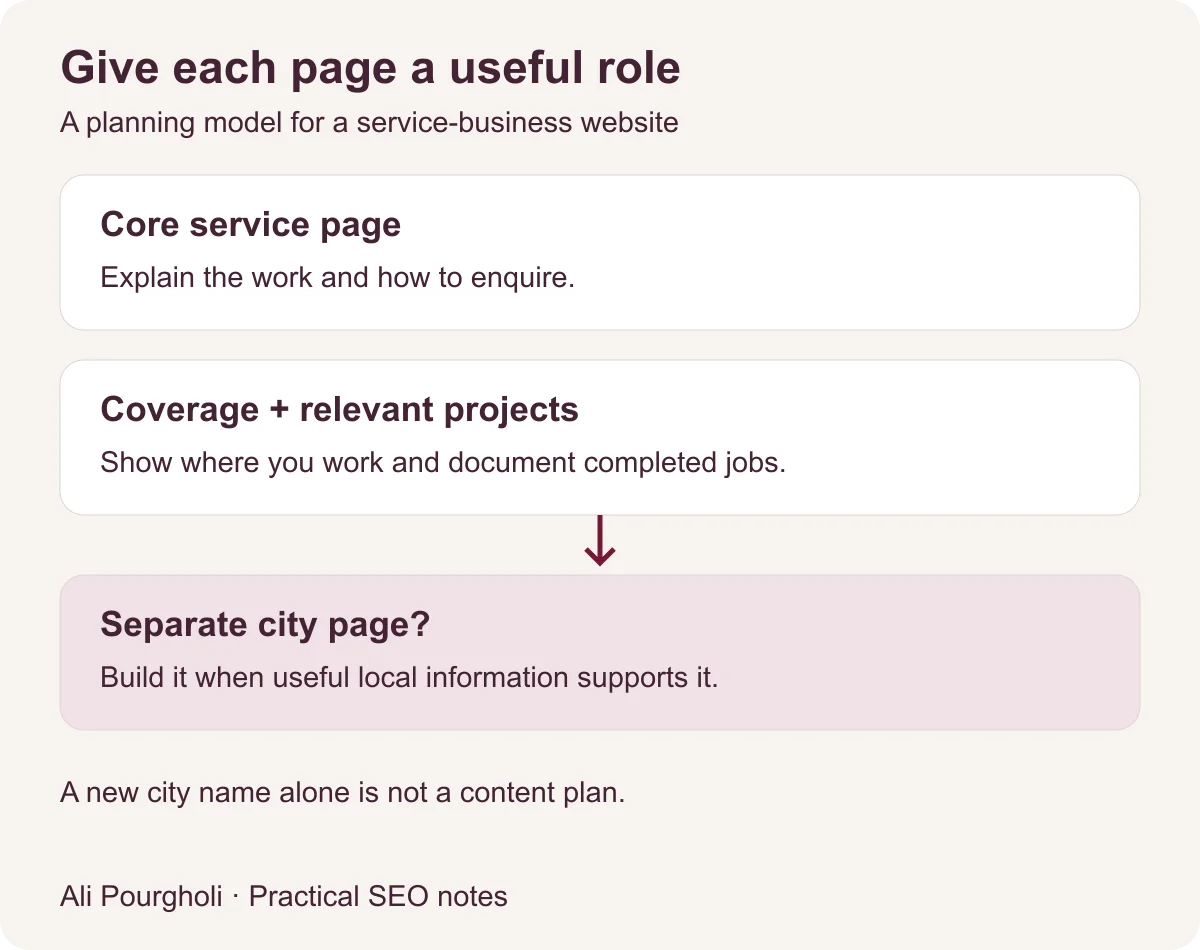
Give each page a useful role
Core service page
Explain the work and how to enquire.
Coverage and relevant projects
Show where you work and document completed jobs.
Separate city page?
Build it when useful local information supports it. A new city name alone is not a content plan.
What if the city pages already exist?
I wouldn’t delete them in bulk.
I’d start by comparing what each page offers and how it performs. In Search Console, I’d look at the queries and landing pages together. I’d also check whether the pages have useful links, enquiries or genuinely distinct content.
Two pages appearing for similar queries doesn’t automatically tell me which one to remove. I need to understand whether they serve different needs or whether the site has spread one topic across several weak pages.
Where pages substantially overlap, combining their useful content into one stronger page may make sense. If a page is retired, its redirect should lead to a relevant replacement.
Where the pages have different jobs, the better solution may be to clarify their focus and improve the links between them.
I also wouldn’t use canonical tags as a blanket fix for a confusing location-page strategy. The first question is whether those pages should exist independently.
Google’s doorway abuse guidance is worth reading here. The concern is creating pages for similar searches that funnel people onwards without providing enough useful value themselves.
We worked on the Business Profile alongside the website
The website wasn’t the only part of the Mason Electric work.
We added more of the business’s services to its Google Business Profile and completed more of the profile information. We’re also publishing posts there weekly.
I see these as complementary tasks. The website gives us room to explain a service properly. The Business Profile gives potential customers another place to understand what the business offers and find a route to contact it.
The weekly posts are part of keeping that information active and useful. I’m not presenting the posting schedule as proof of a ranking improvement.
For each update, the question is straightforward: does this give a potential customer something worth knowing? A relevant service explanation or a documented piece of work has a clearer purpose than publishing another generic message just to fill the week.
Where the results stand today
The new service pages have only recently started to get indexed. The Search Console chart is beginning to move upwards.
That is encouraging, but the work is still at an early stage. We changed the page content, URLs, structure, homepage and Business Profile within the same broader project. I can’t honestly isolate one of those changes and say it caused the movement.
I’m allowing roughly three months to assess how the work develops. That’s a review window for this project, not a promise that SEO produces a particular result after 90 days.
The next review needs to go beyond whether the graph is higher. I want to see:
- Whether the intended service URLs are indexed.
- Which relevant searches are bringing impressions and clicks to them.
- Whether those visits lead to enquiries for work the business actually provides.
The screenshot shared for this article is a cropped view without the full date range and filters. It isn’t enough to calculate a reliable before-and-after increase, so I’m not attaching a growth percentage to it.
For now, this is an account of the work and the early signs we’re monitoring. A results case study comes later, when there is enough evidence to support it.
What I’d prioritise on another service-business website
If your website has thin service pages, start there.
Choose one important service and read its page as a customer. Can you understand what the business does? Can you check coverage? Do you know what information to provide and how to get a response?
Then try that journey on a phone. Check the call link, complete the form and look for anything that makes a straightforward enquiry harder than it needs to be.
Once those foundations work, review where separate city pages could add something useful. Some locations may justify one. Others may be covered perfectly well within the main service page and coverage information.
That’s the lesson from my work on Mason Electric so far: the first opportunity was to make the existing services clearer and more useful. More URLs could wait.
If you’re deciding which service pages to improve and which location pages to build, you can tell me about your website. Through my local SEO work, I can help you turn that list into a practical plan with a clear purpose for each page.